What Global Buyers Look for in a Sustainable Factory in 2026
Published at - August 16, 2026

The global textile and apparel industry is changing. For manufacturers in Bangladesh, competing in international markets is no longer only about price, quality, production capacity, and delivery.
Sustainability is becoming an increasingly important part of the conversation between global brands and their manufacturing partners.
Buyers are paying greater attention to how factories use energy, manage emissions, improve environmental performance, and provide reliable sustainability data. Industry sustainability frameworks such as the Higg Facility Environmental Module encourage factories to track energy use, greenhouse gas emissions, and opportunities for renewable energy and efficiency improvements.
For Bangladesh's textile and RMG factories, this means that preparing for the future requires more than having a green building or a sustainability statement. Factories need measurable actions and reliable data that demonstrate continuous improvement.
1. Renewable Energy Adoption
Energy is one of the most important areas of environmental performance for manufacturing facilities.
Factories are increasingly expected to understand their energy consumption and identify opportunities to reduce energy use and greenhouse gas emissions. Renewable energy is an important part of this transition.
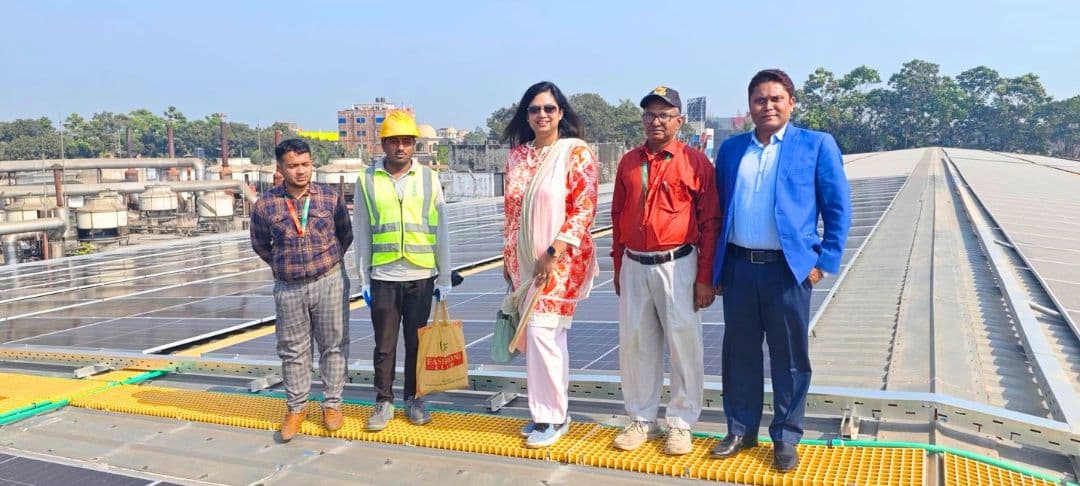
For textile and RMG factories, industrial rooftop solar can provide a practical way to increase renewable energy use.
By using available rooftop space to generate electricity onsite, factories can:
- Increase renewable energy consumption
- Reduce dependence on conventional electricity sources
- Lower operational carbon emissions
- Improve long-term energy management
- Support broader sustainability objectives
Renewable energy is therefore becoming not just an environmental initiative, but an important part of a factory's long-term energy strategy.
2. Measurable Energy and Emissions Data
Sustainability claims are becoming less meaningful without supporting data.
Factories need to understand how much energy they consume, where that energy comes from, and how their operations contribute to greenhouse gas emissions.
The Higg FEM, for example, encourages facilities to identify energy sources, track energy consumption, calculate Scope 1, 2 and 3 emissions where applicable, and develop plans to reduce energy use and GHG emissions.
For manufacturers, this means moving from:
“We are becoming sustainable”
to:
“Here is the data showing our progress.”
Accurate energy records, renewable energy generation data, emissions calculations, and consistent reporting can help factories demonstrate their sustainability performance more effectively.
3. Energy Efficiency and Resource Management
Using renewable energy is important, but sustainability also requires factories to use energy and resources efficiently.
Manufacturers should continuously evaluate major energy-consuming areas such as:
- Production machinery
- HVAC systems
- Lighting
- Compressors
- Motors and pumps
- Cooling systems
Improving efficiency can reduce unnecessary energy consumption while supporting better operational performance.
The goal is not simply to consume cleaner energy, but to produce more efficiently with less environmental impact.
4. Stronger ESG Performance

Environmental performance is increasingly connected to broader ESG expectations. For textile and RMG manufacturers, this means sustainability should be integrated into business operations rather than treated as a separate initiative.
A stronger ESG approach can include:
- Energy and emissions management
- Renewable energy adoption
- Waste management
- Water efficiency
- Environmental compliance
- Worker well-being
- Transparent reporting
- Continuous improvement
A factory that can demonstrate measurable progress across these areas is better positioned to respond to evolving expectations from international stakeholders.
5. Supply-Chain Transparency and Traceability
Transparency is becoming increasingly important across global supply chains.
The European Union's Ecodesign for Sustainable Products Regulation includes a Digital Product Passport framework designed to improve access to product sustainability and supply-chain information. Textiles are among the priority product groups for future sector-specific requirements.
For manufacturers, the direction is clear: reliable information about products, materials, environmental performance, and manufacturing processes is becoming increasingly valuable.
Factories should therefore strengthen their ability to collect, organize, verify, and communicate relevant sustainability data.
6. A Clear Decarbonization Strategy
Global buyers increasingly want to see progress rather than promises.
A factory does not necessarily need to become fully carbon neutral immediately. What matters is having a realistic strategy with measurable targets and continuous improvement.
A practical decarbonization roadmap can include:
Measure → Improve → Transition → Monitor
First, understand current energy consumption and emissions. Then improve efficiency, increase renewable energy adoption, and continuously monitor progress.
For energy-intensive textile and RMG factories, rooftop solar can become one of the practical components of this transition.
What This Means for Bangladesh's Textile & RMG Industry

Bangladesh has built a strong position in the global apparel supply chain. Maintaining that position in the years ahead will require manufacturers to compete not only on cost and production capability, but also on sustainability performance.
Global sustainability expectations are becoming more data-driven, and the apparel industry's decarbonization progress remains an important concern. Cascale's 2026 industry analysis found that the sector is not decarbonizing at the pace required to meet global climate targets, with energy remaining a major source of Scope 1 and 2 emissions.
For Bangladeshi manufacturers, this creates both a challenge and an opportunity.
Factories that invest in energy efficiency, renewable energy, reliable data, and long-term sustainability strategies can strengthen their readiness for an increasingly sustainability-focused global market.
Why Rooftop Solar Matters
Among the different sustainability initiatives available to industrial facilities, rooftop solar offers a particularly practical opportunity.
Large textile and RMG factories often have significant rooftop areas and substantial daytime electricity demand. This creates an opportunity to generate clean electricity where it is consumed.
Industrial rooftop solar can support:
- Renewable energy targets
- Energy cost management
- Carbon reduction
- ESG performance
- Long-term energy planning
- Sustainable manufacturing goals
Solar therefore becomes more than a power-generation system. It can become part of the factory's broader sustainability strategy.
Why Industries Choose Solaric
Moving toward sustainable manufacturing requires the right technology, but it also requires the right implementation partner.
Solaric focuses on industrial rooftop solar solutions designed around the operational and energy requirements of businesses.
With 192+ MW commissioned, 40 MW under development, and 86+ operational projects, Solaric brings extensive experience in delivering and operating industrial solar projects.
Solaric supports businesses through:
- Engineering-driven solar solutions designed for industrial facilities
- CapEx and OpEx/RESCO models to provide flexibility in solar adoption
- Advanced monitoring to track system performance
- Long-term Operations & Maintenance to support the performance of solar assets
- Industrial project experience across textile, RMG, manufacturing, FMCG, and other sectors
For manufacturers, the objective is not simply to install solar panels. It is to develop a reliable clean-energy asset that contributes to energy management, sustainability performance, and long-term business competitiveness.
Building a Factory That Is Ready for the Future

The definition of a sustainable factory is evolving.
In 2026, global competitiveness increasingly depends on a factory's ability to demonstrate measurable environmental performance, manage energy efficiently, increase renewable energy use, and provide reliable sustainability information.
For Bangladesh's textile and RMG manufacturers, the transition should begin with practical steps:
- Measure your energy.
- Improve efficiency.
- Adopt renewable energy.
- Track your progress.
- Build for the future.
Sustainability is no longer simply about meeting today's buyer expectations. It is about preparing for the expectations that will shape tomorrow's global supply chains.
Conclusion
Global buyers are increasingly looking for manufacturing partners that can demonstrate more than production capacity. They want factories that are efficient, transparent, responsible, and prepared for the future of sustainable manufacturing.
For textile and RMG factories in Bangladesh, investing in renewable energy, energy efficiency, emissions management, and reliable sustainability data can help strengthen both environmental performance and global competitiveness.
The factories that begin this transition today will be better positioned to meet the sustainability expectations of tomorrow.
Contact Solaric
Ready to make your factory more sustainable?
Talk to Solaric about how industrial rooftop solar can support your factory's energy, sustainability, and long-term business goals.
Phone: +880 1750-150251
Email: megaroof@solaricglobal.com
Website: www.solaricglobal.com